2022年4月17日星期日

2021年6月1日星期二
Vedio of IPX12 waterproof testing rig
If you find any interesting, visit our website http://www.pegotester.com/IEC60529_IPX1_IPX2_drip_box.html#_jcp=3_2 and contact me sales@pegotester.com.
2019年4月22日星期一
About Blue Light - Pego Group
1. What is bule light?
Blue light does not refer to blue light, but refers to high-energy short-wave blue light with a wavelength between 400nm and 480nm, which has extremely high penetrating power. The blue light in this wavelength will increase the amount of toxin in the macular area of the eye, the death of light-sensitive cells, the gradual decline of vision, and even induce blind eye disease, which seriously threatens our fundus health. Blue light can be seen everywhere in daily life, but the proportion is generally within the normal health range, and has little effect on vision. Long-term exposure will make people’s eye feels burning, and it will be difficult to recover from the eyes.
2. Where does blue light come from?
Blue light exsists in a large number of artificial light sources such as LED screens, LED lights, and fluorescent lights. For example: mobile phones, computer monitors, fluorescent lights, LCD screens, LEDs, etc.
3. How can we detetor the blue light?
OHSP350B blue light hazard tester is a special equipment to fast detect, measure, screen and compare the blue light at site. Detection: quickly detect anti-blue light effects; Measurement: LCD displays measured values in real time; Screening: screen different anti-blue light functions; Comparison: Differentiate anti-blue light levels.
2019年4月15日星期一
Salt Spray Test
Salt spray test is a kind of environment test which adopts a salt spray chamber to simulate a salt fog conditions to evaluate the performance of corrosion resistance. The reference standards includes GB/T2423.17, IEC60068-2-11, ISO4628-3, ASTM B117, JIS-Z2371, JIS-G3141, GJB 150.1, MIL-STD-810F, MIL-STD-883E and etc.
Corrosion is a damage or metamorphism caused by environment, most of corrosion happens under the atmospheric environment, the corrosion factors includes oxygen, humidity, temperature change and pollution, salt-spray corrosion is a usual and most destructive atmospheric corrosion, the corrosion composition is Nacl, it comes from ocean and inland saline.
The salt spray test includes neutral salt spray test (NSS), acid salt spray test (ASS) and copper accelerated acetic acid salt spray test (CASS):
1. NSS test is the most widely test method, it adopts 5% salt water and the solution’s PH value is around 6 to 7.
2. ASS test is developed base on NSS, it requires to add glacial acetic acid into the 5% salt water, and the solution’s PH value is around 3, the corrosion speed is 3 times faster than NSS test.
3. CASS test is the newly fast test method, it requires to add a bit of Cucl, the corrosion speed is 8 times faster than NSS test.
The technical specification includes solution concentration, R.H., temperature, test time, storage time, test period, fog quantity and PH value.

Salt spray test chamber made by Pego has good quality, the material of the body adopts PVC plastic board with features of aging resistance and corrosion resistance; the lid adopts full transparent acrylic board with feature of shock resistance and freely to observe the test procession; Saturated air barrel adopts SUS304 board to provide humidity and temperature according to Henry law. Contact us to get the quotation.
2019年4月7日星期日
The Function of Hand Held Spray Nozzle for IPX3 and IPX4
Spray nozzle is a kind of equipment for IPX3 and IPX4 testing, differs from oscillating tube, the water sprays from round sharp nozzle.
The main parts for the spray nozzle are nozzle and baffle. The material of the nozzle is brass for the purpose of corrosion resistance and precision. There are totally 121 holes, 1 center hole, 2 inner circles have totally 24 holes (12 holes/circle), the interval is 150, 4 outer circles have totally 96 holes (24 holes/circle), the interval is 300. The material of the baffle is aluminum, and it is mobilizable in order to control the watering area. When the nozzle is covered, it means IPX3 testing, when the nozzle is uncovered, it means IPX4 testing.
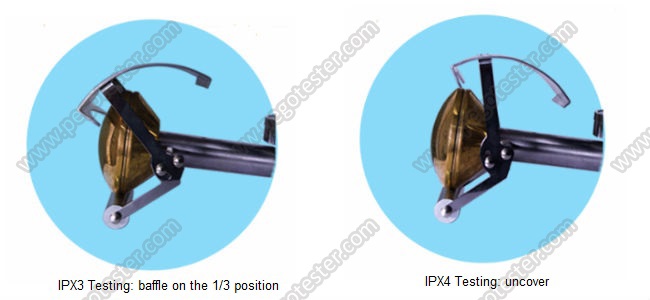
Spray nozzle is usually applied to the samples with big enclosures, it is regarded as the auxiliary equipment for oscillating tube rain test. The oscillating tube is not enough to reach the big equipment, so a hand-held device is needed. The pressure should keep in the 50~150kpa during the test, the test time depends on the enclosure area, 1SQM/min, at least 5 min.
Application: cabinet, washing machine and etc. Pego has full sets of waterproof test equipment, please contact to get more information.
订阅:
评论 (Atom)