2019年5月7日星期二

Introduction for Ground Continuity Test - Pego Group

1. Importance of ground continuity test
Nowadays, the manufacturers of electric and electronic equipment must try best to ensure the safety of the user, and protect the user from electric shock even any fault operation. To reach this public requirement, ground continuity tester must be applied. At the moment, most electric safety execution institutions like UL, CSA, IEC, BSI, YDE, TUV and JSI are requires the manufacturers to do the ground continuity test during the design and production periods.  

2. The AC ground continuity test
Ground continuity tester is applied to test the resistance between earth cable and enclosure according ohm law. Current flow through contact point, test the voltage values of current and contact point separately, then calculate the resistance value according to ohm law. Generally, flow through a big current, the abnormal current caused by simulator under abnormal conditions would be the test standard. If the contact resistance of ground cable can pass the test under bad conditions, the equipment should be safe in the normal conditions. The electronic equipment must do the AC ground continuity test with the following conditions:
a) Function test during the design--- To ensure the new product can reach the demand.
b) Specification test during production--- To ensure the finished product can meet the requirement.
c) Quality test during QA--- To ensure the quality can meet the standard requirements.
d) Safe test after maintenance--- To ensure the product can meet the standard requirements after maintenance

Different products have different technical specification, basically, it would requires a constant current flows through contact point, and keep for a certain time. For example, the resistance of contact point keeps in the normal range during the specify time, then the equipment would be thought as safe when operate in the normal condition. Reasonable design can protect the user from dangerous of accidental electric shock.

Although the contact resistance can be tested by ohmmeter, the ohmmeter can only output small current, which can not meet the standard requirement, and can not be accredited by inspection institutions, ground resistance meter is a must tool. For electronic equipment can often be touched, 30 amp is required by CSA to do the ground resistance test, 25 amp are required by most institutions, like UL, BSI, TUV, VDE and etc. and the resistance of contact point must be lower than 100 mΩ, current must keep for 60s and resistance must keep below 100 mΩ. For electronic equipment can be hardly touched, generally, it will requires 10 amp and resistance must keep below 100 mΩ, and still keep for 60s.

Internationally, some specification would higher than standard, the rated input current requires 5 times of the standard, and resistance of contact point should be 100 mΩ and keep for 60s. Mostly, the motor requires the more strictly test. At the moment, for special demands, ground resistance test should be the priority, the dielectric withstand voltage and insulating resistance test should be done upon pass the ground resistance test.

The ground resistance test has two types, AC and DC, although both type are allowed, but AC ground continuity test is especially recommended.

Pego is specialized in electric safety test equipment, recently, we have ground resistance tester, withstand voltage tester, insulating voltage tester, leakage current tester, LCR meter and DC electronic load.

2019年4月22日星期一

Operation Vedio of Lightning Surge Generator

About Blue Light - Pego Group

1. What is bule light?
Blue light does not refer to blue light, but refers to high-energy short-wave blue light with a wavelength between 400nm and 480nm, which has extremely high penetrating power. The blue light in this wavelength will increase the amount of toxin in the macular area of the eye, the death of light-sensitive cells, the gradual decline of vision, and even induce blind eye disease, which seriously threatens our fundus health. Blue light can be seen everywhere in daily life, but the proportion is generally within the normal health range, and has little effect on vision. Long-term exposure will make peoples eye feels burning, and it will be difficult to recover from the eyes.

2. Where does blue light come from?
Blue light exsists in a large number of artificial light sources such as LED screens, LED lights, and fluorescent lights. For example: mobile phones, computer monitors, fluorescent lights, LCD screens, LEDs, etc.

3. How can we detetor the blue light?
OHSP350B blue light hazard tester is a special equipment to fast detect, measure, screen and compare the blue light at site. Detection: quickly detect anti-blue light effects; Measurement: LCD displays measured values in real time; Screening: screen different anti-blue light functions; Comparison: Differentiate anti-blue light levels.

2019年4月15日星期一

Salt Spray Test

Salt spray test is a kind of environment test which adopts a salt spray chamber to simulate a salt fog conditions to evaluate the performance of corrosion resistance. The reference standards includes GB/T2423.17, IEC60068-2-11, ISO4628-3, ASTM B117, JIS-Z2371, JIS-G3141, GJB 150.1, MIL-STD-810F, MIL-STD-883E and etc.
Corrosion is a damage or metamorphism caused by environment, most of corrosion happens under the atmospheric environment, the corrosion factors includes oxygen, humidity, temperature change and pollution, salt-spray corrosion is a usual and most destructive atmospheric corrosion, the corrosion composition is Nacl, it comes from ocean and inland saline.
The salt spray test includes neutral salt spray test (NSS), acid salt spray test (ASS) and copper accelerated acetic acid salt spray test (CASS):
1. NSS test is the most widely test method, it adopts 5% salt water and the solution’s PH value is around 6 to 7.
2. ASS test is developed base on NSS, it requires to add glacial acetic acid into the 5% salt water, and the solution’s PH value is around 3, the corrosion speed is 3 times faster than NSS test.
3. CASS test is the newly fast test method, it requires to add a bit of Cucl, the corrosion speed is 8 times faster than NSS test.
The technical specification includes solution concentration, R.H., temperature, test time, storage time, test period, fog quantity and PH value.
Salt spray test chamber made by Pego has good quality, the material of the body adopts PVC plastic board with features of aging resistance and corrosion resistance; the lid adopts full transparent acrylic board with feature of shock resistance and freely to observe the test procession; Saturated air barrel adopts SUS304 board to provide humidity and temperature according to Henry law. Contact us to get the quotation.

2019年4月7日星期日

The Function of Hand Held Spray Nozzle for IPX3 and IPX4

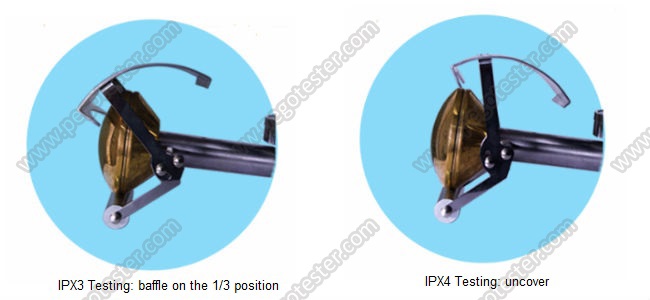
Spray nozzle is a kind of equipment for IPX3 and IPX4 testing, differs from oscillating tube, the water sprays from round sharp nozzle.

The main parts for the spray nozzle are nozzle and baffle. The material of the nozzle is brass for the purpose of corrosion resistance and precision. There are totally 121 holes, 1 center hole, 2 inner circles have totally 24 holes (12 holes/circle), the interval is 150, 4 outer circles have totally 96 holes (24 holes/circle), the interval is 300. The material of the baffle is aluminum, and it is mobilizable in order to control the watering area. When the nozzle is covered, it means IPX3 testing, when the nozzle is uncovered, it means IPX4 testing.  


Spray nozzle is usually applied to the samples with big enclosures, it is regarded as the auxiliary equipment for oscillating tube rain test. The oscillating tube is not enough to reach the big equipment, so a hand-held device is needed. The pressure should keep in the 50~150kpa during the test, the test time depends on the enclosure area, 1SQM/min, at least 5 min.

Application: cabinet, washing machine and etc. Pego has full sets of waterproof test equipment, please contact to get more information. 

2019年4月3日星期三

What are the commonly used waterproof test machine?

For most enterprises, especially the enterprises relatives to electronics, IP grade test is a must to adapt to the customers demands. But how to choose a suitable equipment? According to our experience, we recommend the following equipment:
IPX1 and IPX2 vertical drip test equipment: applied to simulate the rain and 150 rain conditions. Application scope: mobile phone, tablet PC, camera, voice box, outdoor cabinet and etc. Generally, the producer would be customized the drip board according to sample size. There are three types of drip box, box type, wall-hung type and frame type.

IPX3 and IPX4 oscillating tube: Applied to test the protection performance against the raining condition at the angle of 600 and 1800. Application scope: water heater, washing machine, auto parts, computer, transformer, LED luminaire and etc. The oscillating tube has 8 sizes includes 200mm, 400mm, 600mm, 800mm, 1000mm, 1200mm, 1400mm and 1600mm. There are two types, box type and double-pillar type.
IPX5 and IPX6 Jet nozzles: Applied to test the protection performance against the spray water or high pressure spray water. Application scope: outdoor lighting fixture, military products and etc. There are 2 types includes box type and split type.
 I
IPX7 Temporary immersion tank: Applied to test the equipment under the condition of  immersion tank to simulate the equipment under the water of more than 1.2m depth. Application scope: underwater camera, intelligent electronic equipment, underwater monitor and etc. There are 2 types according to the material, includes stainless steel type and stalinite type.

IPX8 continue immersion tank: harsher than IPX7. Mainly applied to the products work under the 1.2m or deeper water. Application scope: diving lamp, diving watch, diving headset, diving camera, diving monitor and etc. As the pressure is big, the tank adopts special pressure bearing device. Customized accept: 10m, 30m, 50m, 60m, 80m, 100m and etc.

2019年4月2日星期二

Which is the better, constant temperature humidity chamber or high low temperature chamber

There are three kinds of environment test chambers for temperature and humidity includes constant temperature and humidity test chamber, thermal shock test chamber and high-low temperature test chamber.

Generally, the lab only do the high temperature and low temperature test, but sometimes, it will also request to do the humidity test, in this case, the constant temperature and humidity test chamber is a must equipment.

The working principles of constant temperature humidity chamber and high-low temperature chamber are the same, and the price has no much difference, so usually we will recommend the temperature and humidity test chamber to our customers.

The specification of the temperature and humidity test chamber as below:
1. Adopts TIME880 controller made by Korea
2.Time setting: 0-999h, with touch screen. Freely set up the temperature and humidity condition.
3. Failure warning and trouble shooting.
4. Temperature sensor adopts DIN PT-100Ω
5. Temperature controller adopts P.I.D.+S.S.R.
6. Alerting if any error occurred during the operation and setting.
7. Remote to monitor and record.
8. Adopts Micro humidification system with two pieces of  magnetic reed switch.
9. The Water barrel is made by stainless steel.
10. Humidity and dry system are independence.
11. The water shall be pure water or RO water.

Pego Tester is engaged in all kinds of environment test equipment, like humidity temperature test chamber, dust chamber, IP waterproof test chamber, vibration machine, tensile equipment, spring impact hammer, pendulum impact hammer and etc. Welcome to contact our sales to get our information.

2019年3月28日星期四

ZY_2 Needle Flame Test Apparatus compares with IEC60695_5_11

1. Application scope

The IEC60695-5-11 specifies a needle test to simulate the effect a small flame which may result from fault conditions, in order to assess by a simulation technique the fire hazard. It is applicable to electro-technical equipment, its sub-assemblies and components and solid electrical insulating materials or other combustible materials.  
2. Description of the test apparatus
1) Burner: the burner to produce the test flame shall consist of a tub at least 35mm long with a bore of 0.5mm±0.1mm and an outer diameter not exceeding 0.9mm.The burner is supplied with butane or propane gas having gas having a purity of at least 95%.  
ZY-2: The burner is made by stainless steel, the size is Φ 0.5mm ± 0.1mm, outer dia.: ≤Φ 0.9mm, Length: 35mm.  
2) Flame: With the axis of the burner in the vertical position, the gas supply is adjusted so that the length of the flame is 12mm±1mm, when viewed in subbdued light against a dark background. The test time for the temperature to increase from 100℃±5℃ to 700℃±3℃ shall be 23.5s±1.0s.  
ZY-2: The burner angle can be adjusted at 450 or 900. The flame height is 12mm ± 1mm (with height gauge), the background is black, the flame requirement is rising time from 100℃±2℃ to 700℃±3℃ should within 23.5s±1s.  
3) Lab chamber: the lab chamber shall have an inside volume of at least 0.5m3. The chamber shall provide a draught-free environment, whilst allowing normal thermal circulation of air pass the test specimen. The chamber shall permit observation of the test in progress. The inside surfaces of the wall shall be a dark color.  
ZY-2: The working dimension is 0.5CBM and made by stainless steel. The equipment with a view-window made by stalinite.  
4) Thermocouple
A sheathed fine wire type K (NiCr/NiAl) with an outer sheath diameter of 0.5mm.
ZY-2: Thermocouple: Φ0.5mm K type
5) Severities
Preferred values of duration of application of test flame are as following:
5s, 10s, 20s, 30s, 60s, 120s
ZY-2:Burning duration: 0-999.9s±0.1s auto record, manual pause
4. Evaluation of test results
The test specimen is considered to have satisfactorily withstood the needle flame test if one of the following situation applies:
a. There is no flame and no glowing of the test specimen and no ignition of the specified layer or wrapping tissue.
b. Flames or glowing of the test specimen and surrounding parts extinguish within 30s after the removal of the needle flame. Also the surrounding parts have not burnt away completely and there has been no ignition of the specified layer or wrapping tissue.  
See from the comparison, ZY-2 needle flame test apparatus completely meets the requirement of IEC60695-5-11. Meanwhile, Pego provides the third-Lab Calibration Certificate authorized by CNAS. Welcome to contact us to get more information. 

2019年3月19日星期二

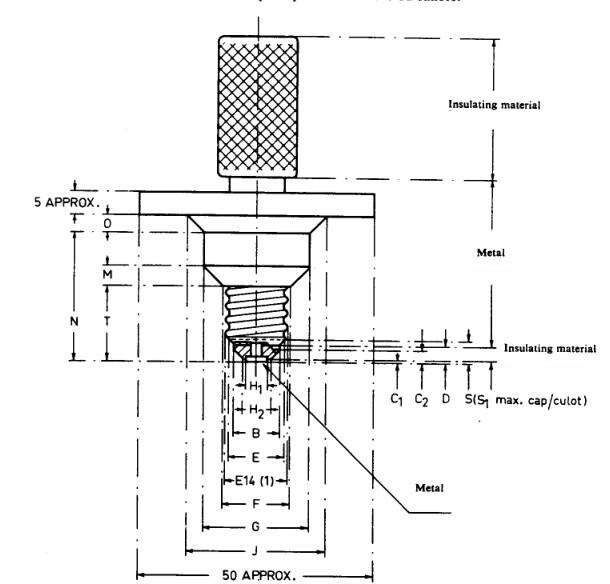
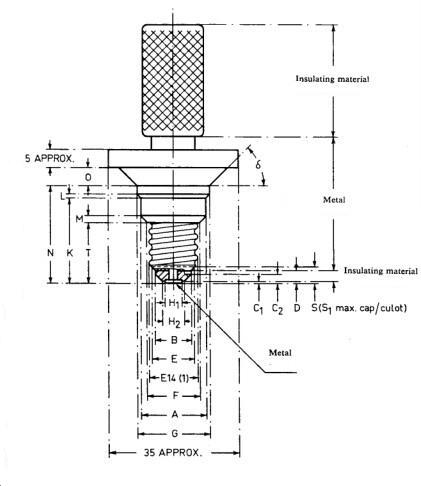
The list of IEC60061_3 E14 lamp cap and lampholder gauges

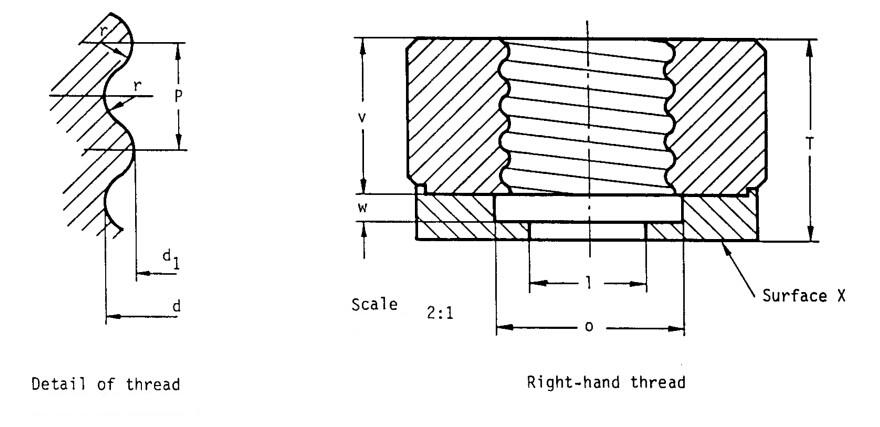
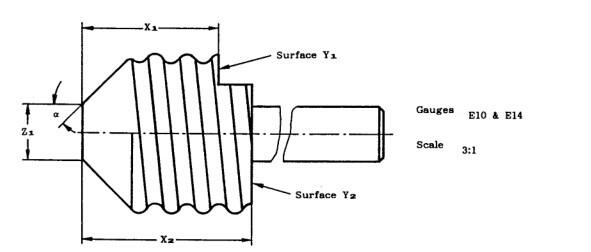
1) Go Gauge for E14 caps on finished lamps (7006-27F-1)
Purpose: To check the maximum dimensions of the screw thread and dimension T1 minimum of E14 caps on finished lamps.
Testing: when the cap on a finished lamp has been screwed into gauge as far as it will go,  the centre contact shall be co-planar with, or project beyond surface X.
7006-27F-1
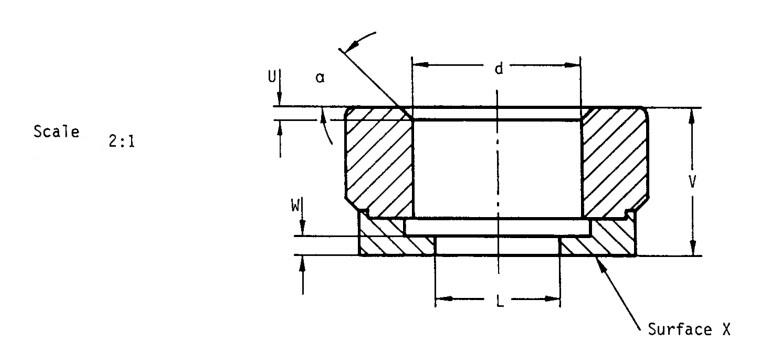
2) Not go gauge for E14 caps on finished lamps (7006-28B-1)
Purpose: to check the minimum outside(major) diameter of the screw thread, dimension d, of E14 caps on finished lamps.
Testing: when the gauge is placed over the thread of the cap on a finished lamp, held cap uppermost, the centre contact shall not project beyond surface X.
7006-28B-1
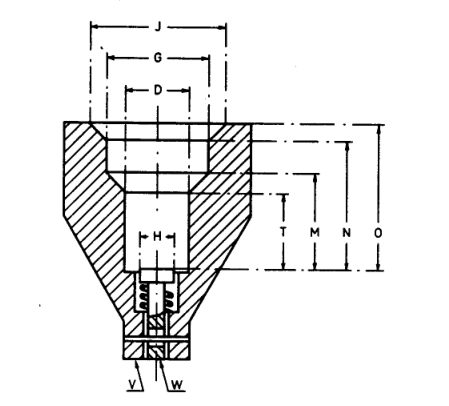
3) Gauge for finished lamps fitted with E14 caps for testing protection against accidental contact (7006-55-2)
Purpose: to check protection against accidental contact
Testing: The shape of the lamp with regard to protection against accidental contact is assumed to be correct if the test sample being pushed as far as possible into the gauge, plane W does not protrude beyond plane V.
Note: The application of this gauge is restricted to the lamps (candle lamps, round bulb lamps, domestic tubular lamps, pygmy lamps) when they are fitted with E14 caps, in according with sheet 7004-23.
7006-55-2
4) Gauge for finished lamps fitted with E14 caps for testing contact making (7006-54-2)
Purpose: to check lamp dimension for contact making in IEC holders
Testing: the shape of the lamp with regard to the fit in the lampholder is assumed to be correct if the lamp can be pushed into the gauge till plane W reaches plane V or projects beyond it.
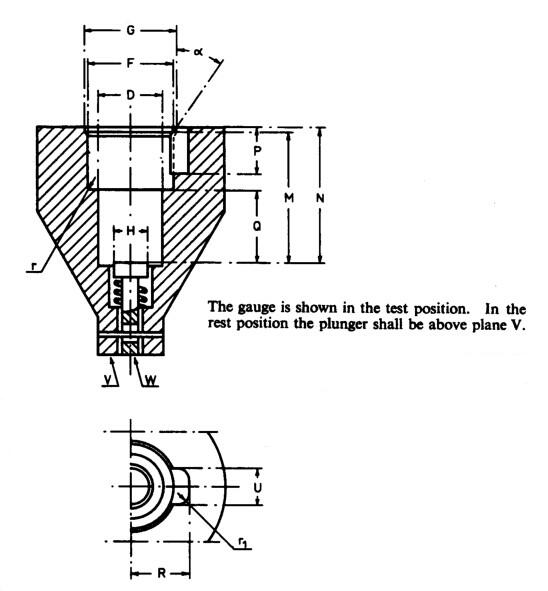
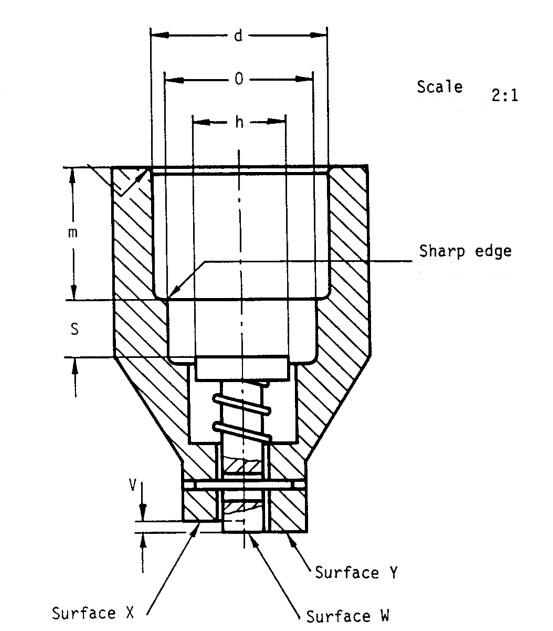
5) Go gauge for dimension “S1” of E14 caps on finished lamps (7006-27G-1)
Purpose: To check the dimensions S1 minimum and S1 maximum of E14 caps on finished lamps.
Testing: When the cap on a finished lamp has been pushed into the gauge as far as it will go, the plunger surface W shall be co-planar with or project beyond surface X but it shall not project beyond surface Y.
7006-27G-1
6) Go gauges for screw threads of E14 lampholders (7006-25-7)
Purpose: to check the minimum dimensions of the lampholder screw thread and dimension X shown on sheet 7005-20
Testing: it shall be possible to screw the gauge into the lampholder without using undue force.
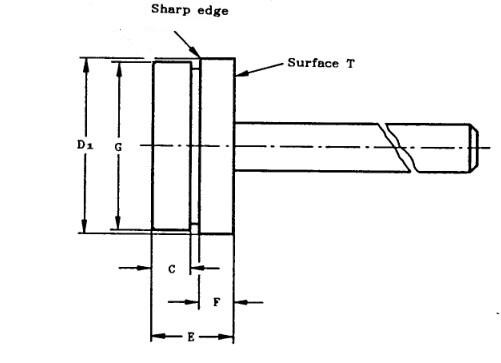
7) Not go gauges for screw threads of E14 lamp holders (7006-26-4)
Purpose: to check the maximum minor diameter of the screw thread, dimension D2 of lampholder E14.
Testing: the screw thread of the lampholder shall be assumed to be correct if the gauge does not enter by its own weight so far that the thread protrudes beyond surface T.
7006-26-4
8) Plug gauge for E14 lampholder for testing contact making ( 7006-30-2)
Note: the application of this gauge is restricted to lampholders for lighting fittings equipped with the lamps (candle lamps, round bulb lamps, domestic tubular lamps, pygmy lamps) when these are fitted with E14 caps, in accordance with sheet 7004-23
9) Plug gauge for lampholder E14 with candle sharped shaft for candle lamps for testing contact making (7006-30A-1)
This gauge is to be used for testing contact making in lampholders with candle sharped shafts designed especially to make candle lamps only.
7006-30A-1
10) Guage for testing contact-making and protection against accidental contact during insertion of lamps E14 lampholder (figure number: 7006-31-4)

Note: the application of this gauge is restricted to lampholders for lighting fitting equipped with lamps (candle lamps, round bulb lamps, tubular lamps, pygmy lamps) when these are fitted with E14 caps, in accordance with sheet 7004-23

2019年3月14日星期四

IEC60335_1 clause 25.14 Requirement for Flexing Test of Supply Cord

Appliances provided with a supply cord which are moved while in operation, shall be constructed so that the cord is adequately, protected against excessive flexing where it enters the appliance.  

The part of appliance comprising the cord entry, the cord guard if any and the supply cord, is fixed to the oscillating member so that when the latter is at the middle of its travel, the axis of the cord where it enters the cord guard or inlet is vertical and passes through the axis of oscillation. The major of the section of flat cords shall be parallel to the axis of oscillating.  

The cord is loaded so that the force applied is:

1) 10N for cords having a nominal cross-sectional area exceeding 0.75mm2.
2) 5N for other cords.  

The distance A between the axis of oscillation and the point where the cord or cord guard enters the appliance, is adjusted so that when the oscillating member moves over its full range, the cord and load make the minimum lateral movement.  

The oscillating member is moved through an angle of 900 (450 on either side of the vertical), the number of flexing for type Z attachments being 20000 times and for other attachments 10000 times, the rate of flexing is 60 per min.  

A flexing is one movement at 900, the cord and its associated parts are turned through with the rated current of the appliance at rated voltage. The test shall not result in:

1. Short circuit between the conductors
2. Breakage of more than 10% of the strands of any conductor
3. Separation of the conductor from its terminal
4. Loosening of any cord guard
5. Damage to the cord or cord guard which could impair compliance with this standard.  
6. Broken strands piercing the insulation and becoming accessible. 

2019年3月13日星期三

The List of Testing Equipment for Plugs and Socket Outlets According to IEC60884_1

1. Test Probe B (jointed test finger) refers to IEC60884-1 clause 10
2. Test probe 11 (unjointed test finger) refers to IEC60884-1 clause 10
3. Ball Pressure test apparatus refers to IEC60884-1 clause 25
4. Ground resistance tester refers to IEC60884-1 clause 11
5. Insulation resistance tester refers to IEC60884-1 clause 17
6. Withstand voltage tester refers to IEC60884-1 clause 17
7. Plug socket breaking endurance test system refers to IEC60884-1 clause 21 and figure 16
8. Verification force plug socket test apparatus refers to IEC60885-1 clause 23.2 figure 20
9. Apparatus for testing cord retention refers to IEC60884-1 clause 23.2 figure 21
10. Tumbling barrel test machine refers to IEC60884-1 clause 23.4 figure 21
11. IK01-IK06 Pendulum impact hammer apparatus refers to IEC60884-1 clause 24.1 and figure 22, 23, 24, 25
12. Low temperature impact test device refers to IEC60884-1 clause 24.4 and figure 27, 42
13. Glow-wire test apparatus refers to IEC60884-1 clause 28.1.1
14. Tracking index test apparatus refers to IEC60884-1 clause 28.2
15. Salt spray test chamber refers to IEC60884-1 clause 29
16. Plug-pin temperature rising tester refers to IEC60884-1 clause 23.3
17. Creepage distance caliper refers to IEC60884-1 clause 27

2019年3月12日星期二

List of test probes - Pego Tester

Probes and applicationProbe codeShort descriptionForce to be applied
Access probes of IEC60529
(IP code)
Probe ASphere:Φ50 with handle50
Probe BJointed test finger10
Probe CRod: Φ2.5-length 1003
Probe DWire: Φ1.0-length 1001
Object probes of IEC60529
(IP code)
Probe 1Sphere: Φ50 50
Probe 2Sphere: Φ12.530
Other access probesPersons against access to_
hazardous live parts or_
hazardous mechanical parts
Probe 11Unjointed test finger50
Probe 12Cylindrical pin: Φ4-length 50
Probe 13Conincal pin: Φ3 to 4-length 15
Probe 14Bar: 3*120
Probe 15Deleted
Probe 16Deleted
Probe 17Wire: Φ0.5
Probe 18Small finger probe: Φ8.6-length 57.910
Probe 19Small finger probe: Φ5.6-length 4410
Other access probesPersons against access_
to hazardous mechanical parts
Probe 31Cone: Φ110/6050
Probe 32Rod: Φ 2530
Probe 33Delected
Other access probesPersons against access_
to hot or glowing parts
Probe 41Probe: Φ 30
Probe 42Deleted
Probe 43Bar: 50*5

Pego Tester has the full sets of test probes, please contact the sales to get more information.

2019年3月11日星期一

Thermocouple - Pego Tester

Thermocouple is a commonly used temperature measuring component in temperature measuring instruments. It directly measures the temperature and converts the temperature signal into a thermoelectric potential signal, which is converted into the temperature of the measured medium by an electric meter (secondary meter). The shape of various thermocouples is often very different due to needs, but their basic structure is roughly the same, usually composed of hot electrode, insulating sleeve, protection tube, junction box and etc., and often equip with display instrument, recording instrument and electronic regulator, like multiplex temperature meter, black test corner and etc.

According to the seeback effect, when two different metals are connected together, there is a contact voltage between the two contact points, which depends on the temperature. The connection of thermocouple materials is standard, and the different properties of the thermocouple materials determine their different applications.
Type
Material
Temperature range
+
-
T
Cu
CuNi
-270℃-400℃
K
NiCr
NiSi
-270℃~1372℃
B
PtRh (30)
tRh
270℃~1820℃
N
NiCrSi
NiSi
-270℃~1300℃
E
NiCr
CuNi
-270℃~1300℃
R
PtRh (10)
Pt
-50℃~1769℃
S
PtRh (13)
Pt
50℃~1769℃
J
Fe
NiCu
-210℃~1200℃

The technical advantages of thermocouple: 1). thermocouple temperature measurement range is wide, performance is stable; 2). measurement accuracy is high, thermocouple is in direct contact with the object to be tested, and is not affected by intermediate medium; 3). thermal response time is fast, and thermocouple has flexible response to temperature change; 4). The measuring range is large, and the thermocouple can be continuously measured from -40 to + 1600 °C; 5). the thermocouple has reliable performance and good mechanical strength. 6). The service life is long and the device is convenient.

2019年3月10日星期日

About Flicker - Pego Tester

As we all know, LED lights are more and more popular with the advantages of energy saving and environmental protection, but if the quality of LED lights is not good, there is a serious strobe. This strobe is undetectable to the naked eye and can easily be ignored by parents and children. LED lights on the market, there may be serious strobe!

1. Where does LED flicker comes from?
Strobe is the depth at which the luminous flux of an electric source fluctuates. The greater the fluctuation of the luminous flux, the more severe the stroboscopic. The depth of the fluctuation of the luminous flux of the electric light source is directly related to the technical quality of the electric light source. Conventional luminaires are powered by alternating current, and their brightness varies with the periodic variation of the alternating current. The strobe of the luminaire is formed by the change of darkness of the light. It is usually divided into two types: one is that the frequency of change is below 100 Hz, and the stroboscopic light can be captured by the human eye; the other is that the frequency of change is above 100 Hz. This strobe will not be seen.

2. What are the potential hazards of stroboscopic effects on the human body?
There are related biological and medical research on the possible damage to the human body caused by stroboscopic:
1). May cause brain cell damage. Some researchers say that by observing EEG, even if the stroboscopic light in the environment is so fast that it is undetectable, the retina of the organism can still resolve and respond to light with a frequency of 100-160 Hz or even 200 Hz. In the animal experiment represented by cats, 100-120 Hz light has caused cell burns in the brain, and the burnt cells belong to the lateral geniculate tissue, which plays a role in controlling the eyeball.
2). May affect reading and vision. Studies have shown that the bright stroboscopic of fluorescent lamps and CRT displays can affect the trajectory of eye movement when people read text. In addition, in some health check reports, visual impairment is caused by stroboscopic fluorescent lamps.
3). Long-term use can cause visual fatigue, and even headaches, especially students, children are more vulnerable. This strobe is undetectable to the naked eye and can easily be ignored by parents and children.

3. How can ordinary people determine whether there is strobe in LED products?
The OHSP-350F Flicker photometer is a portable equipment can carry for site test, it can test scintillation Index, flicker percentage, scintillation depth, flicker frequency, illumination, IES EVE illumination, FFT frequency spectrum, CCT, CRI and etc. And the equipment will prompt risk of flick. However, it focuses on the analysis of stroboscopic data. It can be connected to the PC source to display measurement of flicker frequency, frequency and stroboscopic area waveform.

2019年1月21日星期一

What is JISD0302? - Pego Tester

JISD0302 is the Japanese standard for automobile parts against moisture, rain and spray water. The test grade includes M1, M2, R1, R2, S1, S2, D1, D2 and D3.

1. Classification:
Type
Symbol
Test Purpose
Moisture Test
M1
Auto parts against moisture
M2
Auto parts against high temperature and moisture
Spray Test
R1
Auto parts against water direct contact
R2
Auto parts against rain or spray water indirect contact
Jet Test
S1
Auto parts against rain or jet water direct contact
S2
Auto parts against riptide
Immersion Test
D1
Auto parts against temporary immersion
D2
For checking water immersion auto parts
D3
For checking the special purpose auto parts

2. Test Method
Type
Water Pressure
(Mpa)
Diameter of Nozzles
(mm)
Quanity of Nozzles
Water Flow
(L/min, minimum)
Water Temperature (℃)
Humidity
Temperature difference between EUT and water (1)
Tet time
Operation
M1
-
-
-
-
Around 32
Mixed with air, water drops, steam
-
8h
EUT rotates around the horizontal axis, 1.5 circles/min
M2
-
-
-
-
Around 60
-
1h
-
R1
0.01
-
2
1.9
R.T.
-
-
10min
-
R2
0.03
-
2
3.2
R.T.
-
-
10min
-
S1
0.10
Φ1.2
40
24.5
R.T.
-
-
30min
-
S2
0.30
Φ1.2
40
39.2
R.T.
-
-
1h
-
D1
-
-
-
-
-
-
-
5 min
The water should immersion the upper surface of EUT
D2
-
-
-
-
-
-
About 30
10 min
100mm between water surface and upper surface of EUT  
D3
-
-
-
-
-
-
About 50
10min

Pego has developed splashproof testing machine for R1, R2, S1 and S2 testing according to JISD0203. If you find interesting, please contact us to get further information.